


Stecker Machine Blog

Why Choose a Galvanized Steel Coil Manufacturer?

Choosing the right Galvanized Steel Coil Manufacturer affects durability, processing efficiency, and long-term project cost. It is not merely a purchasing decision. The supplier controls coating consistency, steel chemistry, surface quality, and delivery reliability.

World Steel Association data reports approximately 1.89 billion tonnes of crude steel production in 2023. That scale shows the importance of dependable steel supply. However, global volume does not guarantee suitable galvanized coil. A construction panel may need a clean surface for painting, while an automotive component may require tighter dimensional control. Small coating defects can become visible around cut edges, bends, and drilled holes.

Performance begins with measurable controls.

A qualified manufacturer should document zinc coating mass, mechanical properties, coil width, thickness tolerance, and inspection results. Standards such as ASTM A653 and EN 10346 provide useful reference points, while ISO 1461 is widely used for hot-dip galvanized products. Buyers should also review traceability records, mill certificates, testing equipment, and corrective-action procedures. Certificates alone are not enough.

Zinc-industry expert Dr. Frank Goodwin has stated, “Zinc is a natural, essential element, and it is infinitely recyclable.” That principle supports galvanized steel’s practical sustainability story, but it should not become careless marketing. Coating life still depends on exposure, design, drainage, handling, and maintenance.

The supplier matters greatly.

An experienced Galvanized Steel Coil Manufacturer can recommend coating grades, improve forming performance, and reduce avoidable waste. Yet no manufacturer can solve every design weakness. A realistic evaluation compares technical evidence, production experience, response speed, and total cost—not only the lowest quoted price.
Why Choose a Galvanized Steel Coil Manufacturer?

What Is a Galvanized Steel Coil Manufacturer?

A galvanized steel coil manufacturer produces steel coils with a protective zinc coating. The coating helps reduce rust when steel faces moisture, air, or outdoor exposure. The process usually includes cleaning, heating, coating, cooling, and careful inspection.

A reliable manufacturer controls each stage with measured procedures. Technicians check coating thickness, surface appearance, coil width, and mechanical strength. They may use continuous galvanizing lines for stable production and consistent coverage. Samples are tested for adhesion and corrosion resistance. Batch records also support traceability when questions arise later.

In practical work, small defects matter. Uneven zinc, rough edges, or poor coiling can create problems during stamping and forming. Experienced teams adjust line speed, bath temperature, and tension when conditions change. No process is flawless. Even accurate equipment needs human judgment and regular maintenance. A manufacturer should explain its testing methods instead of making vague promises. It should also provide clear data about coating mass, steel grade, tolerances, and delivery condition. Some suppliers focus heavily on appearance, but internal strength may deserve equal attention. Buyers often need technical guidance, not only a price. A serious manufacturer listens to the final application and recommends a suitable coil specification.

How Galvanized Steel Coils Are Produced and Protected

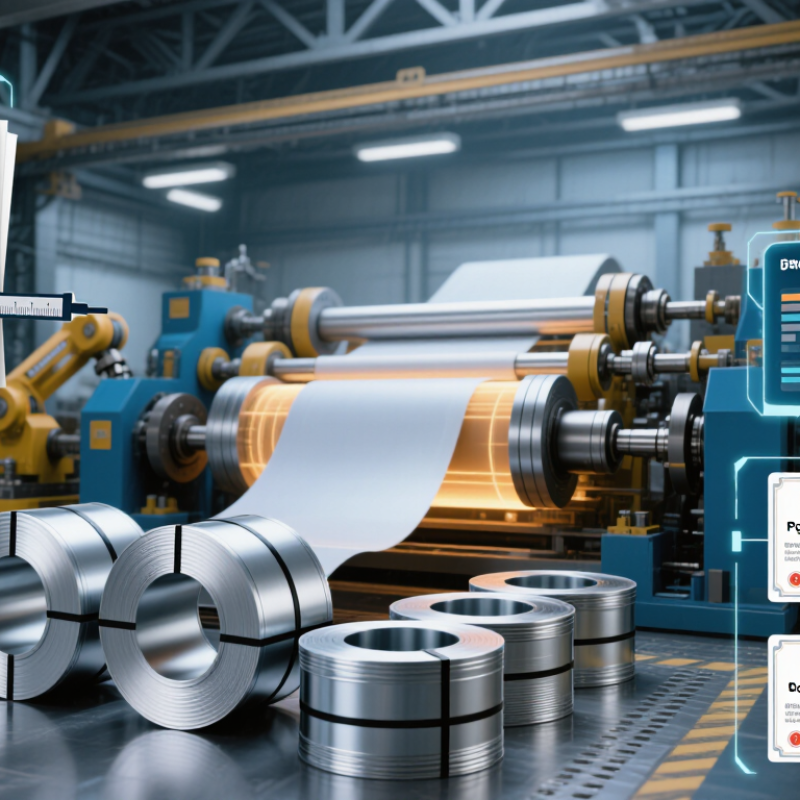
Galvanized steel coils begin with disciplined surface preparation. The strip is degreased, pickled, rinsed, and fluxed before entering molten zinc at about 450°C. The bath is unforgiving. Any remaining scale can create bare spots or uneven adhesion. Air knives then control the coating thickness as the moving strip leaves the bath. Cooling, tension leveling, and recoiling follow. Small defects matter.

EN 10346 identifies Z275 as a coating mass of 275 g/m², approximately 20 micrometers on each side. This zinc layer forms both a physical barrier and a sacrificial shield. If steel is scratched, zinc corrodes preferentially and slows rust formation around the exposed area. The International Energy Agency reports that iron and steel production creates roughly 7–9% of global energy-related carbon dioxide emissions. Efficient lines therefore matter, not only for quality, but also for material and energy control. A reliable manufacturer should provide bath records, coating-weight tests, surface inspections, and traceable coil documentation. Visual checks alone are insufficient. The World Steel Association’s 2024 figures recorded about 1.89 billion tonnes of crude steel production in 2023, showing the scale behind every quality decision. Still, production is not flawless. Edge cracks, roughness, and coating variation can appear when speed, chemistry, or strip temperature shifts. Experienced operators adjust these variables before defects become expensive.

Why Choose a Galvanized Steel Coil Manufacturer? - How Galvanized Steel Coils Are Produced and Protected

Production Stage Key Dimension or Control Typical Data or Range How It Supports Product Quality and Protection
1. Steel Substrate Preparation Incoming steel form Cold-rolled steel strip supplied in coil form Provides a consistent base with controlled thickness, width, flatness, and mechanical properties before coating.
2. Cleaning and Degreasing Surface contaminants removed Oil, grease, dirt, and rolling residues A clean surface improves zinc wetting and reduces uncoated areas, adhesion defects, and premature corrosion.
3. Pickling or Chemical Activation Surface preparation Oxides and scale removed before zinc application Activates the steel surface and promotes metallurgical bonding between the steel substrate and the zinc coating.
4. Continuous Hot-Dip Galvanizing Molten zinc bath temperature Approximately 450°C The strip passes continuously through molten zinc, forming a protective zinc coating and an iron-zinc alloy bonding layer.
5. Coating Thickness Control Total coating mass on both sides Common commercial classes: about 60–275 g/m² Air knives regulate the coating mass to match the intended corrosion-resistance, forming, welding, and application requirements.
6. Alloy-Layer Formation Steel-zinc interface Metallurgically bonded iron-zinc alloy layers Creates stronger adhesion than a simple surface deposit and helps the coating remain attached during handling and forming.
7. Surface Conditioning Surface appearance and finish Regular spangle, minimized spangle, or spangle-free finish Controls appearance and surface uniformity while supporting downstream painting, fabrication, and architectural applications.
8. Cooling and Solidification Coating stabilization Controlled cooling after the zinc bath Allows the zinc layer to solidify evenly and reduces surface defects, coating variation, and handling damage.
9. Skin-Pass and Tension Leveling Dimensional and surface control Light reduction and controlled strip tension Improves flatness, surface texture, shape, and resistance to forming-related defects such as stretcher strain.
10. Passivation or Protective Treatment Temporary storage protection Chemical passivation or equivalent surface treatment Helps reduce white rust, also called wet-storage stain, during transportation and storage in humid conditions.
11. Inspection and Testing Quality verification Coating mass, thickness, width, flatness, appearance, and mechanical properties Confirms that each coil meets the specified dimensional, surface, strength, and corrosion-protection requirements.
12. Recoiling and Packaging Protection during delivery Edge protection, moisture-resistant wrapping, and secure strapping Reduces dents, edge damage, abrasion, and moisture exposure while the coil is stored and transported to the user.
13. Corrosion Protection Mechanism Zinc behavior in service Barrier protection plus sacrificial protection The zinc layer isolates steel from moisture and oxygen; when exposed, zinc can preferentially corrode and provide cathodic protection to nearby steel.
14. Manufacturer Selection Factor Process consistency and traceability Documented controls from substrate preparation through final packaging A qualified manufacturer can provide more consistent coating mass, dimensional accuracy, surface quality, inspection records, and application support.

Note: Actual coating classes, dimensions, mechanical properties, surface finishes, and testing requirements should be specified according to the applicable product standard and the intended end use.

Key Benefits of Buying Directly From a Manufacturer

Why Choose a Galvanized Steel Coil Manufacturer?

Key Benefits of Buying Directly From a Manufacturer

Buying galvanized steel coils directly from a manufacturer gives you closer control over quality, cost, and delivery. You can discuss coating weight, coil width, thickness, and edge condition with technical staff. This reduces misunderstandings between a sales office and the production floor. A reliable manufacturer can also provide mill certificates, inspection records, and batch traceability. These documents help engineers verify performance before the coils reach a cutting line.

Direct communication often improves production planning. Instead of waiting through several intermediaries, you can confirm available stock, rolling schedules, and realistic lead times. Manufacturers may also adjust packaging for long-distance transport, such as stronger strapping or moisture-resistant wrapping. Small details matter. A damaged outer layer can create unnecessary waste during unloading.

Direct purchasing is not automatically easier. Minimum order quantities, payment terms, and production schedules may require careful negotiation. I have seen buyers focus heavily on price and overlook flatness, zinc adhesion, or storage conditions. That decision can become expensive later. An experienced manufacturer should explain these risks clearly, not hide them behind attractive quotations. Ask for sample data, inspection methods, and a response plan for nonconforming coils. Honest answers build confidence, even when the answer is not perfect. Reliable cooperation grows through measurable details, steady communication, and consistent shipment records.

Quality Standards and Customization Options to Consider

Why Choose a Galvanized Steel Coil Manufacturer?

Quality standards should guide the purchase, not just a low quoted price. In coil sourcing, I have learned that small specification gaps can cause serious forming problems. A dependable manufacturer should provide clear data for steel grade, base thickness, coating mass, width tolerance, and surface finish. Test certificates should match the actual production batch. Traceability matters when several coils arrive at once. It helps connect each coil to its heat number, inspection record, and shipment details.

Ask how quality is checked during production. Experienced teams usually monitor coating thickness, flatness, edge condition, tensile strength, and bending performance. Useful testing may include visual inspection, dimensional measurement, adhesion checks, and laboratory analysis. Standards such as ASTM, EN, or ISO can provide a useful framework. They do not replace careful communication. A certificate alone is not proof of consistent performance.

Customization can reduce waste and improve processing efficiency. Buyers may request specific coil widths, inner diameters, coating grades, surface patterns, oiling conditions, or slitting tolerances. Some applications need a smooth surface for painting. Others require stronger protection in humid environments. A thicker zinc coating is not automatically better. It can affect forming, welding, cost, and delivery time. I have seen projects over-specify protection and overlook roll-forming limits. That mistake deserves review. Discuss the final application, storage conditions, cutting method, and expected service life before production begins. Samples and trial coils can reveal issues that paperwork misses.

How to Choose the Right Galvanized Steel Coil Manufacturer

Choosing the right galvanized steel coil manufacturer requires more than comparing price per tonne.

Start with technical control. Ask for coating mass, steel grade, width tolerance, coil weight, and surface finish records. ISO 1461 supports defined zinc-coating requirements, but continuous coil production may follow different specifications. Confirm the applicable standard before ordering.

Reliable manufacturers provide heat numbers, mill test certificates, and production traceability. They should explain how coating thickness is measured and how edge quality is controlled.

The World Steel Association reported global crude steel production of about 1.89 billion tonnes in 2023. This scale shows why supplier discipline matters. Large output does not automatically mean consistent quality. That assumption can fail.

Tips:

Request three recent inspection reports. Check coating results from different coil positions. Ask for loading photos and realistic delivery dates. Compare the supplier’s tolerances with your forming process, not only its brochure.

The OECD’s recent steel outlook continues to highlight excess capacity and weak demand risks. Therefore, financial stability deserves attention too. A supplier offering an unusually low price may reduce inspection, packaging, or service. I have seen specifications accepted too quickly. That mistake becomes expensive during stamping, painting, or outdoor storage.