920-726-4526



Choosing the right Centrifuge Tube is not a minor purchasing decision. It affects sample recovery, operator safety, rotor performance, and result reliability.
Grand View Research reports continued growth in laboratory centrifuge demand, driven by clinical diagnostics, biotechnology, and pharmaceutical research. Fortune Business Insights also identifies automation, high-throughput testing, and stronger laboratory quality requirements as major market drivers. However, these reports often group tubes with broader centrifugation equipment. Their figures should guide planning, not replace technical verification.
Dr. David Rickwood, author of Centrifugation: A Practical Approach, offered a useful warning: “Centrifugation is deceptively simple.” That remains true at the bench. A 50 mL conical tube may look suitable, yet its material, wall thickness, cap design, and maximum RCF can differ significantly. Polypropylene usually supports stronger chemical resistance and higher-speed work. Polyethylene tubes may suit selected applications but require careful compatibility checks. The wrong tube can deform, leak, or collapse inside the rotor.
Start with the rotor manual. Check maximum RCF, temperature range, tube dimensions, fill volume, and adapter requirements. Distinguish RCF from RPM, because the same RPM produces different forces at different radii. Inspect tubes for cracks before loading. Balance opposing tubes by mass, not appearance.
Small details matter. A cloudy tube can hide stress damage. A loose cap can contaminate an entire run. There is no universal best tube. The right choice depends on sample type, solvent exposure, centrifugation force, temperature, sterilization needs, and disposal procedures. Even experienced teams should review these assumptions before routine use.
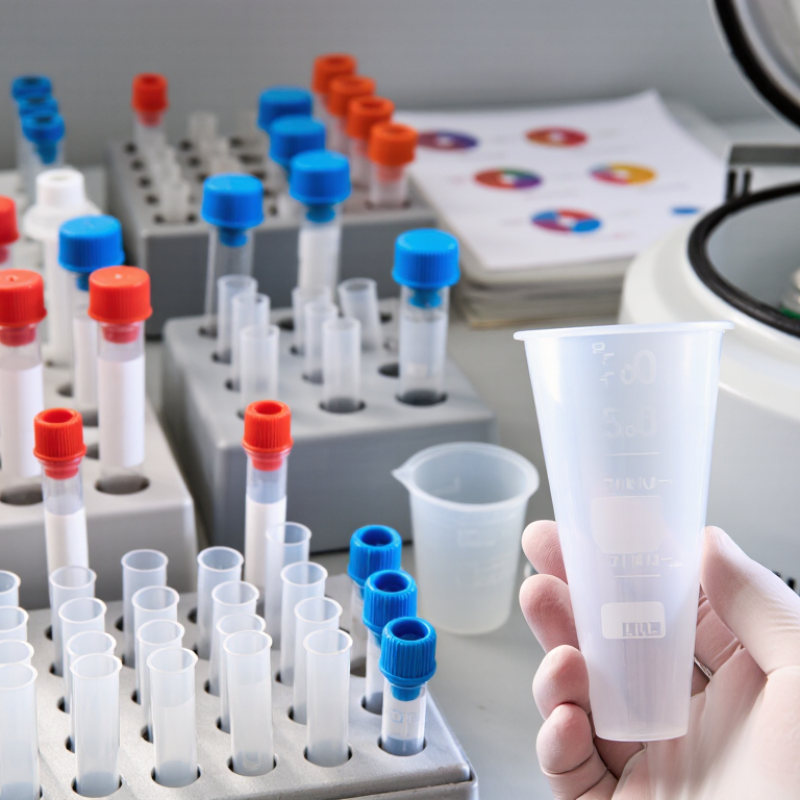
Centrifuge tube types should match the sample, rotor, speed, and temperature. Microcentrifuge tubes suit small-volume DNA, RNA, and protein work. Conical tubes, commonly 15 mL or 50 mL, handle cell suspensions, culture media, and precipitated proteins. Larger tubes support wastewater, food, and industrial sample preparation. Polypropylene tubes usually tolerate strong chemicals and repeated cooling. Glass tubes may suit solvents, but they can break under sudden stress. Never judge compatibility by size alone.
High-speed and ultracentrifuge tubes require special attention. They must withstand the stated relative centrifugal force, or RCF, rather than only the rotor’s RPM. According to a 2024 Grand View Research market report, the global centrifuge market was valued at several billion US dollars in 2023, with continued growth expected through the decade. This expansion reflects broader use in clinical, research, and industrial laboratories. Still, market growth does not make every tube universal. I have found that a slightly wrong tube can deform, leak, or disturb the pellet.
Tips: Check the tube’s maximum RCF, chemical resistance, temperature range, and closure before loading. Balance tubes by mass, not visual volume. Leave headspace when samples may expand during freezing. For clinical specimens, follow current laboratory procedures and applicable quality standards. One detail is easy to miss: adapters must support the tube evenly. A loose fit can create stress at the bottom. Personally, I would record the rotor, tube type, and run conditions after each unusual experiment; this small habit prevents repeated guessing.
| Tube Type | Typical Capacity | Common Material | Typical Working Volume | Typical Centrifugal Force Range | Main Applications | Key Selection Considerations |
|---|---|---|---|---|---|---|
| Microcentrifuge Tube | 0.5–2.0 mL | Polypropylene | 0.1–1.5 mL | Approximately 6,000–30,000 × g, depending on design | DNA and RNA preparation, protein precipitation, cell pelleting, small-volume sample processing | Check rotor compatibility, lid security, chemical resistance, and whether the tube is rated for the required RCF. |
| Conical Centrifuge Tube | 15 mL or 50 mL | Polypropylene | 8–45 mL | Approximately 1,500–20,000 × g, depending on tube and rotor | Cell culture harvesting, bacterial pelleting, protein precipitation, sample clarification, and routine laboratory centrifugation | The conical bottom concentrates pellets; leave headspace to reduce leakage and confirm the tube fits the centrifuge bucket. |
| PCR Tube | 0.2 mL | Polypropylene | 10–200 µL | Usually suitable for brief low- to moderate-speed spins; verify the tube specification | Polymerase chain reaction, qPCR, reagent mixing, and collection of condensation before thermal cycling | Select the correct format for a thermal cycler, such as individual tubes or strip tubes, and use compatible caps or sealing films. |
| Cryogenic Storage Tube | 0.5–5 mL | Polypropylene | 0.3–4 mL | Often suitable for low- to moderate-speed centrifugation; follow the specified RCF limit | Cell and tissue storage, biobanking, sample freezing, and low-temperature sample processing | Use tubes specifically designed for cryogenic temperatures; do not use ordinary tubes for liquid-nitrogen storage unless certified for that purpose. |
| Thin-Wall Ultracentrifuge Tube | 2–40 mL | Polypropylene or polycarbonate | Tube-specific; commonly filled close to the recommended level | Approximately 50,000–1,000,000 × g, depending on tube, rotor, and instrument | Virus and vesicle concentration, ribosome separation, membrane fractionation, and density-gradient ultracentrifugation | Tube material, wall thickness, filling volume, gradient solution, rotor type, and maximum RCF must all be matched precisely. |
| Blood Collection or Serum Tube | 2–10 mL | Glass or polypropylene | Usually filled according to the additive-to-blood ratio | Approximately 1,000–3,000 × g for routine serum or plasma separation | Serum and plasma preparation, clinical chemistry, hematology, and diagnostic sample processing | Choose the correct additive, such as clot activator, gel, or anticoagulant, and follow the required fill volume and spin protocol. |
| Filter Centrifuge Tube | 0.5–5 mL | Polypropylene with a membrane filter | 0.1–4 mL | Approximately 2,000–14,000 × g, depending on filter design | Sample cleanup, protein precipitation, particulate removal, and small-volume filtration | Membrane material and pore size determine chemical compatibility, retention, flow rate, and analyte recovery. |
| Glass Centrifuge Tube | 1–100 mL | Borosilicate or other laboratory glass | Varies by tube design; avoid overfilling | Usually low to moderate RCF; always follow the certified rating | Solvent extraction, analytical chemistry, heat-resistant procedures, and applications requiring low gas permeability | Glass is chemically resistant but brittle; inspect for chips or cracks and use suitable adapters and balanced loading. |